22 March 2012

a story

Sometimes in life, you think you're heading to a certain destination, but you suddenly find yourself traveling to another.
[January, en route to MCC Mesoamerica retreat]
And on your way to this destination, some things will be familiar.
[My image of Guatemala at age 10: Crush soda, chicken buses and Gallo beer
below: tamales with Keila and Rachael, SALTers currently in Honduras and Costa Rica]
And it's good to make the most of this new and unexpected turn of events.
[With Isabel]

You might even love it...

...but you´ll know deep down, that another place has your heart for the moment
[Hilary, 3]
That other place is more than a physical location, it's people too.
[MCC Mexico. Small but mighty. And interestingly, the only MCC team in Mesoamerica to have children under the age of 7.]
So you'll go back home.
[Graffiti in San Cristobal] 

You'll eat,
[My host family is convinced they've been eating more healthily since I arrived...I'm not convinced :)
Hilary's 3rd birthday party]
play,
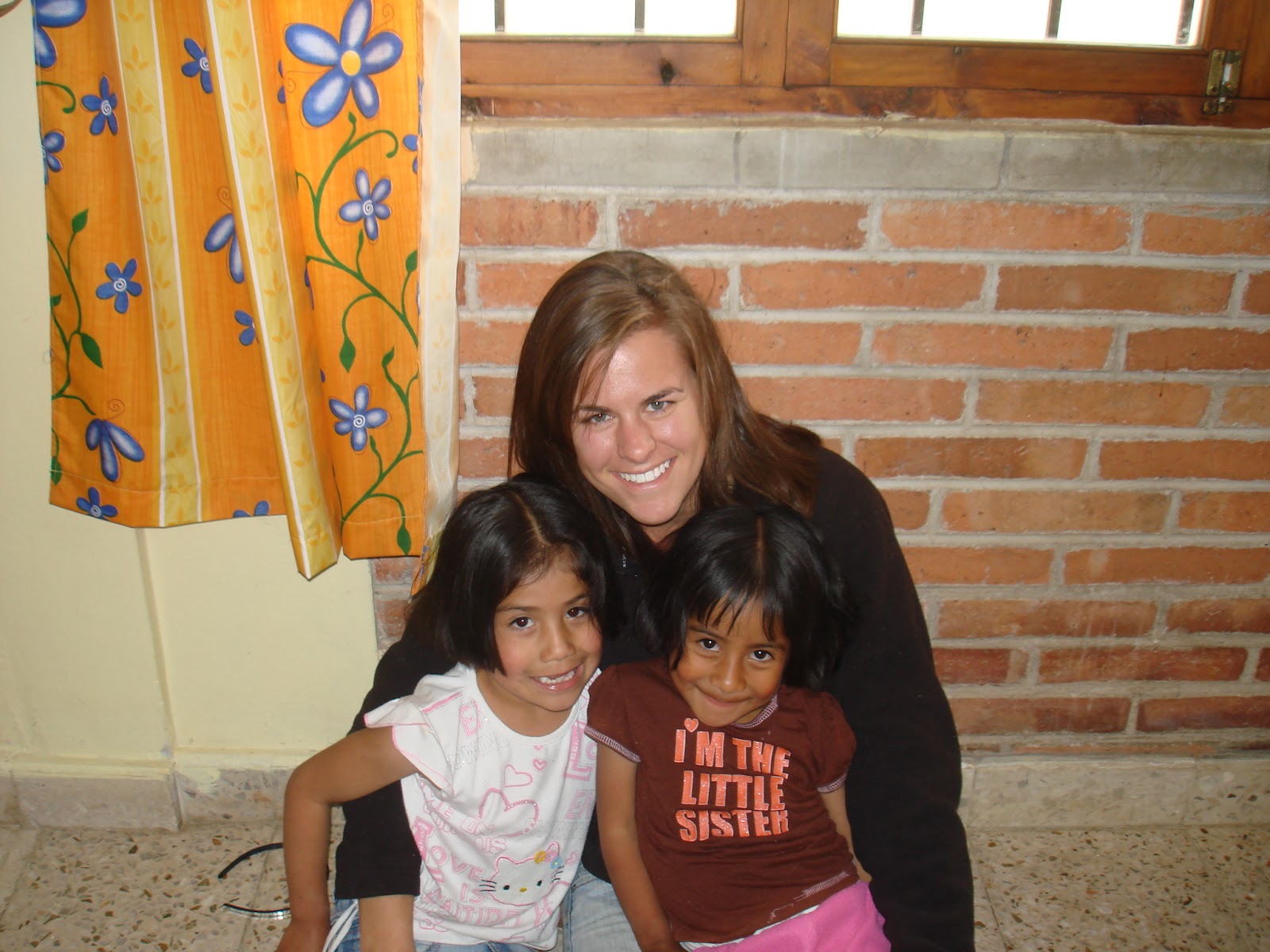
[Yami and Nicole, daughters of Cristy, who cleans our house every Friday.]

Work.
[Beet and bean seeds for planting INESIN's garden.]


The work won't be so bad when you're having fun.
[Elena, Natanael and Dario; planting INESIN's garden]
For a while, being at home is great. But sometimes you have to push your boundaries again...
[Cacti grove at Mayan ruins of Tonina]
...and step into the danger zone.
[Chiapa del Corzo fair
below: while this one might not look as dangerous, don't be fooled. To reach this bell, I had to walk across a grate above a 50 m drop and according to my host grandmother, if women enter Catholic bell towers, the bells will crack. And those things are NOT light.]

Danger zones imply risk and on new adventures you might risk breaking your favorite sunglasses,...
[Day trip to Toniná]
...but there are moments that make the risk worth taking.
[Oldest tree along the Rio Grijalva, Chiapa del Corzo]
When the wonder you inevitably experience isn't inspired by nature, it might be sparked when you're reminded of how small the world is.
[Representing Ohio State and San Francisco Community College in southern Mexico; Jaguares vs. Estudiantes soccer match, Tuxtla]
Along the way, you'll realize that there is a lot you don't know.
[yes, even though I attended a Mennonite college, I understand close to nothing about soccer]
But one thing you do know: along the way, you'll meet new friends...
[Huixtán]
...which makes you happy.
So happy, that the fact you might find yourself perched atop a decapitation altar doesn't even freak you out that much.
[Toniná]
On your adventures, you might also explore caves with exits that look like the state of Chiapas...
...or find the perfect leaves for steaming tamales...
...or meet someone who loves your new sunglasses almost as much as you loved the ones that broke.
As you take all of the beauty around you in, you will probably need to pinch yourself a few times.
[Huixtán]
After assuring yourself that you really are awake,...
[Elena's nieces and nephews after a rousing game of "duck, duck, deer"]
...you'll remind yourself to hold onto every. fleeting. moment...
...because like the grasshopper perched on your finger, you can't hold on forever.
[With Elena's Tzotzil-speaking niece and grasshopper. Communication was limited by the fact that I don't speak Tzotzil or grasshopper.]
Soon you'll be back in familiar territory once again, if only for a week...
[Mom and Dad visit]
...with the food,...
[lunch at Lagos de Montebello...meeting Dad's request of eating as much authentic food as possible]
...and the people you've always loved.
[Cathedral in San Juan Chamula]
Don't get too comfortable, though. When you think you finally know what to expect, you might suddenly find yourself in the middle of a herd of cattle.
[On the way to Sima de las Cotorras]

29 February 2012

The Giant Cosmic Lottery

There are moments when life seems so surreal that you think you must be observing someone else´s from a great distance...that it can´t be your own. I seem to be experiencing many such moments this year. The latter part of last weekend presented me with many chances to step back, take a deep breath and live deeply into these fleeting and oftentimes surreal moments.  

My most recent adventures began after an intense three days assisting with a workshop on Pastoral Accompaniment in Situations of Domestic Violence. After wrapping up the workshop and finally uploading INESIN´s new website (you can check it out here...don´t judge too much. This was my first foray into the world of website design and construction), I decided to take a personal day and traveled with two co-workers, Elena and Dario, to the municipality of Huixtán. Thursday morning found us walking into the parish where Elena worked prior to her time at INESIN. For me, Catholicism has always been shrouded in mystery: maybe it´s the insense that wafts through the cathedral during mass, maybe it´s the Latin, or maybe its because as a non-catholic partaking in the eucharist and making the sign of the cross are not done. Whatever it is, as I walked into the rectory living room (a place I had never imgained I would enter) and ate chips with the joke-cracking priests, I felt like I was peeking into a secret world. My amazement only continued as I jumped into the bed of a pick-up with them and trundled through the forest in search of a laguna which we found after at least an hour of searching.

Later that day, I sat by a river and lunched on roast chicken, rice, beans and handmade tortillas with Elena, Dario and four indigenous sisters (only one of whom spoke Spanish). We settled down to eat only after picking our way, barefoot, through a pitch black cave. In the evening we visited three of Elena´s friends, each in turn offering us coffee and sweet bread. As a rule, I never drink coffee after 6 pm and never willfully add sugar. I broke both self-imposed rules three times that evening in the spirit of accepting hospitality and because, let´s be honest, I´ve been getting far too attached to the daily combination of sweet bread dipped in coffee. I´m sure I will continue to compulsively coffee-dip any cookie, cracker or piece of bread within reach upon completion of my time here.

After crashing in the parish´s dormitory, Elena awoke Dario and me before 6 am to make the trek to her home. After descending from the highway a good 15 minutes on a steep, dirt trail, we reached Elena´s home. It was everything I imagined a Mexican campesino home would be: chickens heating themselves under a roaring fire in the kitchen, beans and fresh corn bubbling away in pots and a kitten weaving its way through my ankles. I even got to grind corn and flip tortillas on the hot comal. We spent the morning hiking through the Chiapanecan highland with Elena´s parents, brothers, sisters, nieces and nephews. We collected foliage for their rabbits, visited the recently planted corn and beans, hauled wood, shot shotguns, caught crabs and grasshoppers and then rested (quite sweatily) and finished off two three-liter bottles of Coke. After lunch, I spent the afternoon playing duck, duck, goose (I couldn´t remember how to say goose in Spanish, so the game became "duck, duck, deer") with the nieces and nephews. We didn´t always understand each other as I was communicating in Spanish and they, primarily in Tsotsil, but somehow between the sun, dirt, laughter and running, we became friends.

My adventure of a weekend continued on Saturday with a trip to Tuxtla Guitérrez (the capital of Chiapas) to watch my first professional soccer match. The Jaguares (Chiapas´ team and the one I root for along with Gabriel, much to Liliana and Eduard´s dismay due to the fact that they are avid Puma fans) won(!) and I left the stadium to the drumbeats of diehard fans. Saturday evening ended with the baptism party of a family friend. As I munched on tamales and sipped hot chocolate on a chilly patio, the reality of my last three days hit me like a brick. As I listed everything I had done, I realized that very few Mexicans would ever experience this unique combination of activities in such a short timeframe. Many living in communities don´t have the means to attend a professional soccer match (even with the rock-bottom $40 peso pricetag) and many Mexicans with the means to attend this sporting event wouldn´t choose to visit an indigenous community. Everything I experienced in these three days was a Mexican reality, but experiencing them all at once is certainly not common.

Since this weekend, I´ve been reflecting on the giant comic lottery that is life. What luck of the draw landed me in southern Mexico this weekend, seeing the sun-kissed mountains and the cast-aside Coke bottles, smelling the bay leaves and the horse poop, hearing the trickling stream and the roar of fanatic fútbol fans, braiding the thick black hair of Elena´s niece and licking the mole off my fingers? What luck of the draw gave me a birth family with significant economic resources and a home in one of the most "developed" nations of the world? Some would say it´s all part of God´s plan, but I´m more of a fan of the "giant cosmic lottery metaphor."  Yes, I believe that God is all around me, around each one of us. I believe God accompanies us in every step of our journey, but I think our circumstances stem from a variety of factors including a good dose of chance and context.

On Friday, as I hiked with Elena´s sister-in-law, Areceli (me in my tennis shoes and t-shirt, her in her heavy skirt and embrodered blouse), we got to chatting and she asked me how old I was. I responded that I had just turned 23 on December 2. She responded that her birthday, too, is December 2nd. Normally I refrain from asking Mexican women their age (it´s just not done here), but since she asked first and I got really excited about our shared birthday, I took the plunge. I don´t know what I was expecting (I´m a terrible judge of age), but 24 was certainly not it. This woman has a husband, three children, ages 7, 8, and 10 and all the responsibilites that go along with family life. When she revealed her age, I worked hard to keep my jaw from dropping to the floor. This woman and I share a birthday, but in so many ways our lives are radically different. The fact that she had her first child at 14 and I, at 23, have no plans of become a mother for at least five years blew my mind. Yes, I theoretically know that females can give birth at age 14. I know that in many cultures childbearing is expected much earlier than in the culture I come from. But this woman wasn´t a statistic; I played with her children, ate at her table and realized through the process that if one of us had been born in a different context, we could be good friends. But the giant cosmic lottery dealt us different hands. And we will both go our different ways, But I hope to see her again because I liked her and she told me that she loves to have visitors.

We´ll see if the giant cosmic lottery brings us together again. And maybe I´ll stack the cards a bit and make sure that it does.
19 February 2012

Knitting with chopsticks

I had many knitters in my life before I came to Mexico: my mom whose first knitting project from years ago was a washcloth that ended up stuffed in her bathroom closet; my aunt Terri who has nurtured my knitting soul, Elizabeth, who knows how to knit a uterus and Sher who sent me and Liliana and me enough yarn to keep us occupied until the end of my stay here.

And in the last months, many new knitters have been added to my life: Liliana who knits faster than anyone I´ve ever met; Elena, who´s teaching me the embroidery techniques from her community, San Gregorio Huixtán as I teach her to knit; Erendida who just went through her first chemotherapy treatment for breast cancer and still brings her knitting with her when she participates in workshops at INESIN; Doña Lucy, who is currently working on a sweater for her new baby grandson while the potatoes boil or the chicken roasts in INESIN´s kitchen. And then there´s Eduardo who doesn´t knit, but watches my progress intently and makes me laugh every time he calls my knitting needles "chopsticks."

I´ve realized recently, that knitting is not just something to keep my hands occupied when watching a movie or chatting. It´s also a powerful way for me to connect. I´ve been introduced to a bakery owner (also an avid knitter) who wants me to give her the pattern for a hat I made. I´ve spent rainy mornings sitting in the kitchen with Doña Lucy, exchanging knitting techniques. A few nights ago I introduced Liliana to the wonders of Ravelry, a social media website for knitters. Last week, Elena and huddled in the office after work to embroider, knit and talk.

Knitting has given me an instant connection with many people here. It has then proceeds to facilitate an even deeper connection, provides the space to discover commonalities and differences in a nonthreatening and organic way.

The women I´ve met here don´t use double-pointed needles and stitch Continental exclusively. I´ve yet to see them use a written pattern, something I fear to stray from. Their lives are quite different than mine in more significant ways, too. After all, I´m the youngest of the knitters I know here and we were raised in different cultures and speaking different languages. I´ve found that to fully appreciate differences, it helps to first find something that unites, because when you can see a piece of yourself in another, suddenly it becomes easier to rejoice in their triumps and refrain from instantly judging their flaws.

So when I experience moments here of feeling different, misunderstood or lonely, I´m going to remember to search for what unites us. And when I´m not, I´ll continue this search and also try to understand our differences and why they matter.

Either way, I´ll keep knitting because I really want to finish this pair of socks before my parents come in two weeks and it´s looking like I made a big mistake when I recently ripped out a big chunk. After all, it´s really hard to pick up the stiches with chopsticks.

06 February 2012

Immigration from another side of the border wall

In 2009, the U.S. census bureau reported that the U.S. has the 2nd largest Hispanic population in the world. (Can you guess who we followed? Yep. That would be Mexico.) Based on this information, I'll venture a wild guess that almost everyone who has lived in the U.S. for the past 23 years has interacted with Latin Americans in one context or another. I, of course, am no exception. Every day, Spanish could be heard ringing out though Harrisonburg High School's hallways. I served as a Spanish translator at Harrisonburg's Patchwork Pantry and Goshen's Center for Healing and Hope. Before coming to Mexico, I followed stories about detained immigrants and even had the chance to write a blog post about Pedro Guzman's celebrated release after 20 months in a Georgia detention center during my time as an intern at Witness for Peace this summer (you'll have to scroll down to the May 19 post to read my writing).

thanks jesus for this food de nadaThe "immigration issue" is everywhere and certaintly provokes strong emotions. There are many who would love nothing more to see all Latin American immigrants deported (I think of Goshen city council member Dixie Robinson, who I interviewed for a project in my Violence and Non-violence class during my last year at Goshen College). There are others who actively fight to help immigrants achieve the rights they deserve, and there are many who fall somewhere in between.  Needless to say, the issue is polarizing and complex. During my last few months here, I've seen (thank you Facebook) several interesting social commentaries that remind us of these complexities. A friend here in San Cristòbal shared an episode of South Park (a show I had never watched before) with me. "The Last of the Meheecans" provides a provocative (and crude) commentary about how the many of those with an "anti-immigrant" stance would respond if all Latin American immigrants returned to their country of origin. The above meme has been making its way around cyberland and speaks to the vital role many Latin Americans play in the cycle of U.S. food production and consumption.
And now, as I experience this issue from the other side of the border wall, complexity adds to complexity. From my current vantage point, I`m reminded that Mexico isn't only a country to be escaped, it's also a destination. This country receives many immigrants from other Latin American countires. The majority of Central American immigrants cross the border in Chiapas. The southern border of Mexico (a mere 2.5 hours drive from San Cristòbal) is overflowing with migration checkpoints and it is not uncommon to be riding on a combi near the southern border, only to have migration officials trudge on, ask for identification and yank off Central Americans who don't present proper identification. 

My experiences here have also reminded me that migration doesn't only change the composition of the U.S. Many Mexican's I've met here have family working in "the North." Those without documentation required by the U.S. face an incredibly dangerous journey if they want to return home. Many don`t. Last week my friend Tone told me about his uncle`s absence over Christmas because he`s currently living in L.A. Many Mexican immigrants don't want to leave their home and family, but many see no other opportunity to provide for their family. There are organizations working to address this reality. For example, one objective of INESIN's Strengthening Communities project, is to provide Mexican families with an alternative to migration through family gardens which provide both food for self consumption as well as a possible source of supplemental income. Though making a living through small-scale agriculture in Mexico became significantly more difficult after the introduction of NAFTA in 1994 (due to imported, subsidized grain from the U.S., among other factors), vegetable gardens provide one way for families to meet their basic need for food.

Of all the migration stories I've heard while here, Ivan's sticks with me the most. Christmas Eve found me on a bus to the airport in Tuxtla Gutierrez, capital of Chiapas. I was the only passenger as the bus wound its way down from the Chiapas highlands to tierra caliente. I spent the one hour+ bus ride, chatting with the driver, Ivan.  Like me, he was away from home that Christmas Eve. As we talked, he told me of the eight years he spent in Georgia working his way up the chain of command at IHOP.  Those years included two harrowing border crossings, one walking through the desert with the help of a coyote at age 16, the other four years later after a visit home, this time swimming. Ivan remembered his time in the U.S. with fondness. He considered his wage exceptional in comparison to what he would have been making in Mexico with only a high-school education. He made great friends. He even named his first daughter after an IHOP coworker. After the birth of his daughter, a few years back, he made the decision to stay in Mexico.  "She's my world," he told me. Now Ivan works as a bus driver for Mexico's OCC enterprise. He said it was the best work someone without a college degree could hope for and feels grateful for the work, even though his family lives over three hours away and the work doesn't permit him to get home as often as he would like. Ivan dreams of being an English teacher one day and I know he could do it even though I have no doubt that many of his students would end up with his Georgia twang. I hope he has the chance to realize his dream.

Hearing stories like this is one of the most powerful parts of my experience in Mexico. As is learning about immigration from this side of the border wall.   

22 January 2012

And never, never to forget

Between January 16 and 22, I returned to Guatemala, land of chicken buses, Quetzales, Crush soda and Gallo beer. More important than these trivial details, though, I consider my current next-door neighbor the birthplace of my love for Latin America. When I was ten, my parents and I took our annual summer vacation to Quetzaltenango (Xela), Guatemala.  For two weeks, we lived with a host family and studied Spanish. While my Spanish skills may not have developed significantly during these two weeks (I failed to grasp the significance of the verb conjugation cards my teachers made me, though I fell in love with the black tea served at breaks and the many games I played during hours of classes), something about the culture and people of Guatemala and Latin America spoke to me and has been growing inside me for the last 13 years. For me, living in Mexico is living the dream, as was having the opportunity to return to Guatemala, to a place that in one way or another was the catalyst for this part of my life journey.

What took me to Guatemala for a week, you ask? The MCC Mesoamerica retreat in Santiago Atitlàn.  For several days, around 60 MCCers serving in Mexico, Guatemala, El Salvador, Nicaragua and Honduras gathered for a time of fellowship, spiritual renewal and discussions on the theme "development work in violent contexts." Though at times overwhelming to be with so many new people, I was inspired by those of all ages serving with MCC in Mesoamerica. I thoroughly enjoyed the opportunity to visit the home and workplace of my fellow SALTer Aaron and the chance to be reminded that my work here and that of the other seven MCCers in Mexico is part of something bigger.  It was also wonderful to soak up the sun on the beautiful Lake Atitlan by boat, foot and kayak, all the while in the shadow of three impressive volcanoes.

The theme for our week, development work in violent contexts, spoke to me in a very unique way. As I listened to the stories of my fellow MCCers and the presentations of our guest speaker, Erlinda de Robledo from San Pedro Sula, Honduras, I realized what a unique situation I am in. In comparison to where many other MCCers are serving, I am in an incredibly safe city. I've begun to take for granted the fact that I can walk alone until 9:30 at night, a good three hours after sunset, the fact that I can take a taxi by myself at any time of the day or night, and the fact that I rarely feel scared or threatened here.This, in contrast with those who rarely go out after sundown or who need to keep some money in an easily accessible pocket at all times in case of an assault or robbery.

My reflections on this theme went beyond personal safety and I found myself contemplating the violent contexts of the countries in which those of us in Latin America live. In my October 20 post, I struggled with the extreme violence and injustice I was learning about here in Mexico. For my first several months, the pace of my heart increased every time I passed a soldier or private security guard with an immense and imposing gun. And I saw this a lot, owing to the fact that Chiapas is one of the most militarized state in Mexico. I cried over the massacres, drug-related killings and the abundance of innocent incarcerations. My stomach turned over every time I saw a gruesome photo of a dead body painted across the cover of a "newspaper" that, to me, seemed more like a tabloid. But over time, I realized at this retreat, I`ve found ways of steeling myself to these tragedies. I`ve found ways of garding my heart to more easily live into the rush of work, family time and a full social life. With this realization, aided by the reflection time provided throughout the retreat, came a wave of horrifying realizations: the realization that some of these situations no longer hit me as hard as they did during my first months; the realization that yesterday I stopped at a gas station with a friend and didn`t blink an eye at the huge guns the military men toted; the realization that I am, in fact, becoming immune and hardened. This hit me like a sharp blow to the gut and it further affirmed my belief that exposure to violence and injustice has the potential to numb the pain. And I don`t want to succumb. Even though pain hurts, I don`t want it to stop hurting. Because when it stops hurting, you can start to forget. Or you can become indifferent. And then you can stop caring and stop acting against violence and for peace. And I don`t want to stop acting.

So this retreat reminded me to fight the urge to get too comfortable. And it reminded me not to forget. That`s one of the reasons I studied history at Goshen College...because I think we can use the past to shape the future. But it doesn`t work if we forget.

In contemplating this blog post, I remember a powerful text that a dear friend, Julia, shared with me in the latter part of last year. It now adorns my bedroom wall along with other quotes, pictures and cards that many of you have sent with me this year. And now I share it with you:

To love. To be loved. To never forget your own significance. To never get used to the unspeakable violence and vulgar disparity of life around you. To seek joy in the saddest places. To persue beauty to its lair. To never simplify what is complicated or complicate what is simple. To repeat strength, never power. Above all, to watch. To try to understand. To never look away. And never, never to forget. -Arundati Roy-
So here`s to never forgetting.      

07 January 2012

Beaches, Birthdays and Bingo: bringing 2011 to a close

November and December brought me increasing comfort in my daily life in Chiapas. It brought multiple chances to explore my surroundings outside of San Cristóbal.  It brought many days filled with Skip-bo, nights full of salsa dancing, deeper connections, new friends and the passage of many holidays both familiar and unfamiliar. These months brought my first visitor, my 23rd birthday and most importantly, an increasing sense of peace in who and where I am in this world. But enough of my words, dear reader. I´ll let the images do the rest of the talking. 

Magaly--Gabriel´s sister
A weekend at the beach: Boca del Cielo
Photos courtesy of Lucie


Lathering on the sunscreen. Be proud, Dad, very proud.
I think I´m third from the left
Because what´s a weekend at the beach without seafood? 
The shark empanadas were probably my favorite.
Though you can´t tell, this sunset gave way to one of the
starriest nights I´ve every experienced. It was magical.
This is the little girl I wrote about in my Thanksgiving post:
the one who wished we would all become stars one day.
Día de la Revolución parade
20 November
My 23rd birthday was one of, if not the best I´ve ever experienced.
After taking the traditional face-bite of my tres leches cake at INESIN,
I returned home to a lunch with my family and the Blocks. These are the
delicious lemon pound cakes Jaquie baked and the card written by Ezra.
The two candles along with another in the shape of a red apple that adorned
my room when I arrived became my advent wreath during the month of December.
Excessively excited to turn 23!!!!!
Eduardo attempting (though only partially successfully)
to avoid being captured in this momentous photo.
And the evening ended with a party with friends.
Meet Nicolas and Luis! Photos again courtesty of Lucie.
   
And the happiest part of my wonderful day:
EEYORE PIÑATA!
Marie and Lucie--party-organizers extraordinaire
Saturday at Rancho Nuevo
Even a day-outing couldn´t keep Liliana and me
from our Skip-bo addiction.
Carne asada
Chiapas: my beautiful home
Chiflón: one of the many waterfalls in this water-filled state

A day at Lagos de Colón with INESIN
Young-adult Christmas celebration at the Presbyterian church
I´ve been attending. During this evening I had the honor of
being a judge for the American Idolesque caroling competition.
Too bad I´ve never actually watched the show :)

In true Mexican form, I´m getting my fill of piñatas this year.
Amanda

Abi at the grill during INESIN´s Christmas party
And yes, I ate the meat :)
  
This is Miriam, MCC Chiapas´ newest team member. She came
in late November and is renting an apartment on my street. The
week before Christmas we got together for a morning of cookie-baking.
Liliana and Eduardo stopped by to help
Peppernuts, sugar cut-outs and a few lime shortbread cookies. 
The rest are featured in the center of the table as lime butter
brittle! oops :)
Elena, teaching me to embroider
And then came Christmas and Joe, my first visitor.  On Christmas Eve
we ate cookies, drank hot chocolate, read the Christmas story and my
favorite copy of The Night Before Christmas, mailed by my wonderful mother.

Christmas fireworks. I won´t even venture a guess
at how many of these things exploded from the middle
of December until 6 January (Día de los Reyes Magos).
On the way to Palenque.
New Year´s Eve. We filled the evening with fireworks, LOTS of
meat (I even sampled raw beef) and bingo.
I thought the midnight toast would bring the evening´s festivities
to a close, but apparently changing the calendar only helped spice
the party up.  Instead of scurrying off to bed, we spent the next two
hours dancing around the living room.
Joe and I did a lot over his almost two weeks here, though you
won´t see it reflected in these photos.  Somehow his camera (which
we had used for visually recording our adventure) got lost. To
compensate, on the last two days I took an excessive number of
photos of our trip to the Lagos de Montebello.

And I name this one "out of a Land´s End catalogue"
Straddling the Mexico/Guatemala border at Lago Internacional

I received endless grief from two Swiss men we met for my inadequate
footwear.  BUTIT´SNOTTHERAINYSEASON!!! How was I to know?

Elote with chile and lime. About as Mexican as you can get.
Our guide at a sinkhole reachable only by horseback.


I call this one "Almost out of a North Face catalogue"     

Happy New Year, dear readers!  Thanks for joining me on the journey.